Adivasi Society 2026: Rights, Culture, Education & Opportunities
Aug 9, 2026
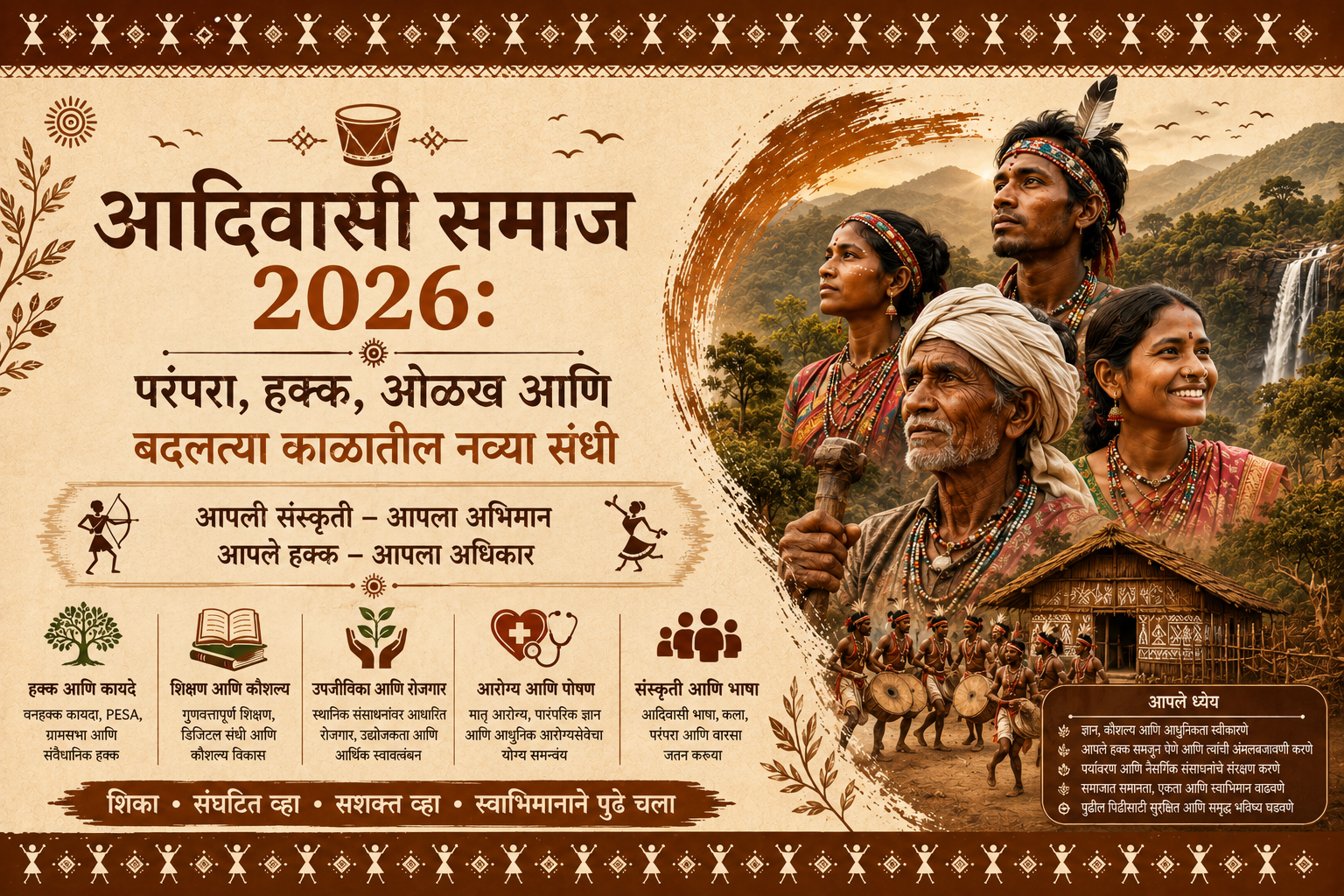
Adivasi Society 2026: Tradition, Rights, Identity and New Opportunities in a Changing World
9 August 2026 | World Indigenous Peoples Day
Every year on 9 August, the world observes the International Day of the World's Indigenous Peoples. The day is not simply an occasion to celebrate Indigenous culture, traditions, art and ways of life. It is also an opportunity to reflect on the rights, identity, traditional knowledge, health, education and future development of Indigenous communities.
For 2026, the United Nations has chosen the theme “Honouring Indigenous Midwives: Safeguarding Life and Well-being.” The theme highlights the knowledge and contribution of Indigenous midwives, particularly their role in maternal and child health and the preservation of traditional knowledge passed from one generation to another.
However, the issues facing Indigenous communities today go far beyond preserving traditions.
The larger question is:
How can Indigenous communities preserve their cultural identity and traditions while gaining equal access to modern education, technology, healthcare, employment and development opportunities?
New stories, art and recipes from Adivasi life — delivered gently, once a month. No noise.
Understanding the Identity of Adivasi Communities
The word “Adivasi” is often associated with forests, traditional dances or folk art. However, the identity of Adivasi communities is much broader than these commonly seen representations.
Across India, different Scheduled Tribe communities have their own languages, dialects, social systems, traditions, agricultural practices, art, music, festivals, environmental knowledge and community-based ways of life.
Key Characteristics of Adivasi Communities
Distinct languages and dialects
Rich folk traditions and indigenous art
A close relationship with nature
Traditional agriculture and forest knowledge
Local knowledge of medicinal plants
Community-based decision-making
Folk music, dance and literature
Cultural knowledge passed from generation to generation
Therefore, “Adivasi culture” is not a single culture but a diverse collection of cultures belonging to many different communities.
Respecting this diversity is one of the fundamental requirements of meaningful Indigenous development.
Do Tradition and Modernity Have to Conflict?
One of the important questions facing Adivasi society today is how traditional identity can be preserved while embracing modern development.
Modern society offers opportunities through education, the internet, Artificial Intelligence, modern healthcare, the digital economy and global employment. At the same time, languages, traditions, traditional knowledge, land and forest-based ways of life also need to be protected.
These two directions do not necessarily have to conflict.
A Balanced Direction for the Future
Tradition + Modern Education + Technology + Awareness of Rights + Economic Self-Reliance
A balanced combination of these elements can create stronger opportunities for future generations.
An Adivasi student can become an AI engineer while continuing to preserve their mother tongue.
An Adivasi woman can build a modern business while using traditional skills to create products.
A young farmer can use modern agricultural technology while preserving the traditional agricultural knowledge of the community.
Becoming modern does not require abandoning one's identity.
The Relationship Between Forests, Land and Adivasi Communities
For many Adivasi communities, forests are much more than natural resources.
Their relationship with forests is connected to food, medicine, employment, culture, traditions and everyday life.
Over generations, Indigenous communities have developed knowledge about local plants, water sources, seasonal patterns, agriculture and biodiversity.
At a time when climate change and biodiversity loss are becoming increasingly important global concerns, this traditional knowledge deserves renewed attention.
Why Is Traditional Knowledge Important?
Protecting traditional knowledge does not simply mean preserving old practices.
It includes:
Preserving community knowledge
Protecting Indigenous languages
Documenting traditional medicinal knowledge
Protecting biodiversity
Preserving folk art and oral traditions
Passing knowledge to future generations
At the same time, when traditional knowledge is digitized or commercially developed, community consent, intellectual property and fair participation in the benefits must be considered.
Why Is It Important to Know Indigenous Rights?
When discussing the development of Adivasi communities, awareness of rights is one of the most important subjects.
India has several laws and constitutional provisions concerning Scheduled Tribes and traditional forest-dwelling communities.
The official Knowledge Hub of the Ministry of Tribal Affairs provides information on important laws and regulations, including the Forest Rights Act, 2006 and PESA Act, 1996. Ministry of Tribal Affairs — Knowledge Hub
Forest Rights Act, 2006
The Scheduled Tribes and Other Traditional Forest Dwellers (Recognition of Forest Rights) Act, 2006 is an important law that recognizes certain traditional forest-related rights of eligible Scheduled Tribes and other traditional forest dwellers.
According to information released by the Government of India in February 2026, 44,33,940 forest rights claims had been disposed of as of 31 December 2025, including individual and community claims. Press Information Bureau — Forest Rights Claims
These figures are significant, but having a law and ensuring that eligible people actually receive their rights are two different things.
Awareness of the law, proper procedures and local-level awareness therefore remain extremely important.
PESA Act, 1996
The Panchayats (Extension to Scheduled Areas) Act, 1996 — PESA is an important law concerning local self-governance in Scheduled Areas.
PESA gives particular importance to the role of the Gram Sabha in local governance and community participation.
Why Is the Gram Sabha Important?
A Gram Sabha is more than simply a village meeting.
It provides local residents with an important platform to discuss issues concerning their village and participate in decision-making.
Therefore, active and informed Gram Sabhas are important for strengthening local democracy in Adivasi areas.
Education: The Most Important Investment in the Future of Adivasi Society
Quality education is one of the most important foundations for the long-term development of Adivasi communities.
Education is not limited to attending school or college.
What Does Meaningful Education Provide?
Access to information
The ability to ask questions and think critically
Awareness of rights
Digital and technological skills
Skills for employment
Financial decision-making abilities
The ability to understand and address community issues
Today, Adivasi students have opportunities in many fields beyond traditional career paths.
Emerging Career Opportunities for Adivasi Students
Information Technology
Artificial Intelligence
Cybersecurity
Engineering
Medicine
Law
Civil Services
Research
Agricultural Technology
Digital Marketing
Design
Finance
Entrepreneurship
Skilled Trades
The Ministry of Tribal Affairs provides various educational schemes and scholarships for Scheduled Tribe students. Ministry of Tribal Affairs
The Digital Divide: A Major Challenge for the Future
The internet has dramatically expanded access to education, employment and information.
However, having a mobile phone does not automatically mean having meaningful digital access.
What Is Needed for Digital Inclusion?
Reliable internet connectivity
Access to computers and digital devices
Digital literacy
Knowledge of online applications and services
Digital content in local languages
Guidance for online learning
Awareness of cybersecurity and online fraud
Therefore, digital inclusion should become an important part of Adivasi development during the coming decade.
New Opportunities for Adivasi Youth
Today's Adivasi youth can connect with a much wider world than previous generations could.
Through the internet, young people can:
Access online education
Complete skill-development courses
Prepare for competitive examinations
Work as freelancers
Build digital businesses
Learn coding and Artificial Intelligence
Sell local products online
Create digital content about their languages and cultures
An Important Challenge
Having opportunities available and knowing about those opportunities are two different things.
Many young people may face a lack of guidance and accurate information rather than a complete lack of opportunities.
Therefore, Career Guidance, Skill Development and Digital Literacy should receive greater attention in Adivasi areas.
From Employment to Entrepreneurship
The development of Adivasi communities should not be understood only as helping every young person find a government job.
Government employment remains important, but strengthening local economies and entrepreneurship is equally valuable.
Opportunities Based on Local Resources
Adivasi regions have valuable local resources and skills related to:
Forest products
Bamboo
Honey
Agricultural products
Handicrafts
Traditional art
Local food products
Tourism
Local services
With appropriate processing, branding, packaging and access to markets, these areas can generate new employment and business opportunities.
“How can an Adivasi young person create employment for themselves and others?”
The Role of Adivasi Women
Adivasi women play an important role in community life.
Their contributions extend across agriculture, forest-based livelihoods, household economies, childcare, traditional knowledge and community life.
The 2026 United Nations theme gives special recognition to Indigenous midwives and their knowledge related to maternal health, child health and cultural continuity. UN DESA — Indigenous Midwives
What Is Needed for Women's Empowerment?
Quality education
Accessible healthcare
Economic independence
Skill development
Digital literacy
Safe employment
Leadership opportunities
Participation in decision-making
Empowering women does not benefit only individuals. It can strengthen families and communities as a whole.
Healthcare and Traditional Knowledge
The 2026 theme of the International Day of the World's Indigenous Peoples draws attention to an important aspect of Indigenous healthcare.
Many Adivasi communities have preserved traditional knowledge related to health and childbirth across generations.
However, respecting traditional knowledge should go together with access to safe and modern healthcare.
What Should the Right Approach Be?
A balanced approach can bring together:
Respect for traditional knowledge + Safe modern healthcare + Community participation + Women's health and decision-making
Traditional knowledge should not automatically be treated as a replacement for modern medical care. Instead, safe and culturally appropriate healthcare should be strengthened while respecting valuable community knowledge.
The 2026 theme emphasizes recognition of Indigenous midwives and culturally appropriate healthcare. UN DESA — 2026 Theme
PM JANMAN and PVTG Communities
The Government of India has launched the Pradhan Mantri Janjati Adivasi Nyaya Maha Abhiyan — PM JANMAN for Particularly Vulnerable Tribal Groups (PVTGs).
The initiative focuses on improving access to essential services and facilities for PVTG communities.
Major Areas Covered Under PM JANMAN
Safe housing
Clean drinking water
Education
Healthcare and nutrition
Roads
Telecommunications
Electricity
Sustainable livelihoods
According to official information, PM JANMAN is being implemented for 75 PVTG communities across 18 States and one Union Territory. Ministry of Tribal Affairs — PM JANMAN
The ultimate impact of such initiatives, however, depends on whether the intended services actually reach eligible families and communities.
Preserving Language and Cultural Heritage
Language is much more than a tool for communication.
A language carries a community's:
History
Folklore
Oral traditions
Proverbs
Traditional knowledge
Understanding of nature
Cultural memory
The loss of a language can therefore mean the loss of an important part of a community's cultural knowledge.
Opportunities in the Digital Age
Adivasi youth can use technology to create:
Digital dictionaries
YouTube channels
Podcasts
Audio archives
E-books
Mobile applications
Wikipedia content
Online learning resources
This can help preserve languages while also making them accessible to younger generations.
Artificial Intelligence and Adivasi Knowledge
Artificial Intelligence is developing rapidly and can potentially help document Adivasi languages, oral traditions and cultural materials.
However, it also raises important questions.
Questions That Need to Be Considered
Has the community given consent?
Which information should be publicly available?
Which knowledge should remain within the community?
Who controls data used to train or build AI systems?
If the information generates commercial value, does the community benefit?
Therefore, data sovereignty, privacy, consent and intellectual property rights should be considered when digitizing and using Adivasi knowledge.
Development Should Happen With Community Participation
Adivasi regions need roads, schools, hospitals, electricity, internet connectivity and employment opportunities.
There is no question about the importance of these facilities.
However, development should not be measured only by the number of infrastructure projects completed.
Meaningful Development Should Include
Participation of local communities
Understanding of local needs
Environmental protection
Respect for cultural identity
Protection of legal rights
Sustainable employment
Education and healthcare
Community participation in decision-making
People whose lives are directly affected by a development decision should have a meaningful place in that decision-making process.
Development for people should also become development with people's participation.
Key Priorities for Adivasi Society in the Coming Decade
The next stage should not focus only on increasing the number of government schemes. It should also focus on measuring their actual impact.
1. Quality Education
Every child should have access to quality education and opportunities for higher education.
2. Digital Inclusion
Internet connectivity, digital devices and digital skills should become more accessible.
3. Healthcare
Greater attention should be given to healthcare in remote areas, maternal and child health, and nutrition.
4. Economic Self-Reliance
Employment opportunities should be complemented by local businesses and entrepreneurship.
5. Women's Empowerment
Women should have greater access to education, employment and decision-making.
6. Forest and Land Rights
Awareness of the Forest Rights Act and related legal rights should be strengthened.
7. Local Self-Governance
Awareness of PESA and the role of Gram Sabhas should be increased.
8. Language and Culture
Adivasi languages, folk traditions and traditional knowledge should be documented and preserved.
9. Youth Skill Development
Young people should receive opportunities to develop skills in IT, AI, cybersecurity, engineering, healthcare and other emerging fields.
10. Community Participation
Local communities should have meaningful participation in decisions affecting their development and future.
What Can Adivasi Youth Do Today?
Today's Adivasi youth can become not only beneficiaries of government schemes but also leaders and contributors to the next generation of their communities.
Every young person can try to
Learn at least one new skill.
Explore available scholarships and educational opportunities.
Learn about laws and rights affecting their community.
Document and preserve information about their local language and culture.
Help other students in their village access educational information.
Verify government scheme information through official sources.
Avoid forwarding misinformation and unverified claims.
Consider entrepreneurship alongside employment.
Use technology to preserve and promote culture.
Build a responsible voice around issues affecting their community.
What is the theme of World Indigenous Peoples Day 2026?
The official 2026 theme is “Honouring Indigenous Midwives: Safeguarding Life and Well-being.”
Why is World Indigenous Peoples Day observed?
The day aims to raise awareness about Indigenous peoples' rights, cultures, languages, traditional knowledge, identity and development challenges.
How are Adivasi communities constitutionally recognized in India?
In the constitutional framework of India, eligible Adivasi communities are primarily recognized as Scheduled Tribes (ST).
What is the Forest Rights Act?
The Forest Rights Act, 2006 is an important law recognizing certain forest-related rights of eligible Scheduled Tribes and other traditional forest-dwelling communities. Ministry of Tribal Affairs — Knowledge Hub
What is PESA?
PESA stands for the Panchayats (Extension to Scheduled Areas) Act, 1996. It is an important law concerning local self-governance in Scheduled Areas and gives significant importance to the Gram Sabha.
Who is PM JANMAN intended for?
PM JANMAN is specifically aimed at 75 Particularly Vulnerable Tribal Groups (PVTGs) across 18 States and one Union Territory. Ministry of Tribal Affairs — PM JANMAN
Are scholarships available for Adivasi students?
Yes. The Central and State Governments provide various scholarships and educational schemes for eligible Scheduled Tribe students. Eligibility, income limits and other requirements vary by scheme, so applicants should check the relevant official government portal before applying.
Why is preserving Adivasi languages important?
Language carries a community's history, folklore, traditional knowledge and cultural memory. Preserving a language therefore means preserving an important part of the community's cultural heritage.
How can modern technology benefit Adivasi communities?
Technology can support education, employment, healthcare access, awareness of government schemes, online marketing of local products, language preservation and documentation of traditional knowledge.
What is most important for the development of Adivasi communities?
No single factor is enough. Education, healthcare, employment, rights awareness, digital inclusion, women's empowerment, cultural preservation and meaningful community participation all need to work together.
Conclusion
The history of Adivasi communities is not simply a part of the past. It is an important part of India's present and its future.
The relationship with nature, traditional knowledge, community life, languages and cultural diversity are major strengths of Adivasi society. At the same time, modern education, technology, entrepreneurship and digital opportunities are creating new possibilities for the future.
We need a form of development in which traditions are preserved without stopping progress, modern opportunities are embraced without losing cultural identity, and development takes place without excluding the voices of local communities.
Adivasi communities do not need development alone. They need development with their rights, identity, knowledge, participation and decision-making power protected.
World Indigenous Peoples Day should therefore be more than a day of celebration. It can also become a day to make a commitment:
Let us preserve our identity. Let us understand our rights. Let us embrace education and technology. Let us protect our languages and cultural heritage. And let us empower the next generation.
Best wishes to all Adivasi communities on World Indigenous Peoples Day 2026.